AZ-Data-Engineering-End-to-End
Modernizing On-Premises Infrastructure with Azure and Databricks
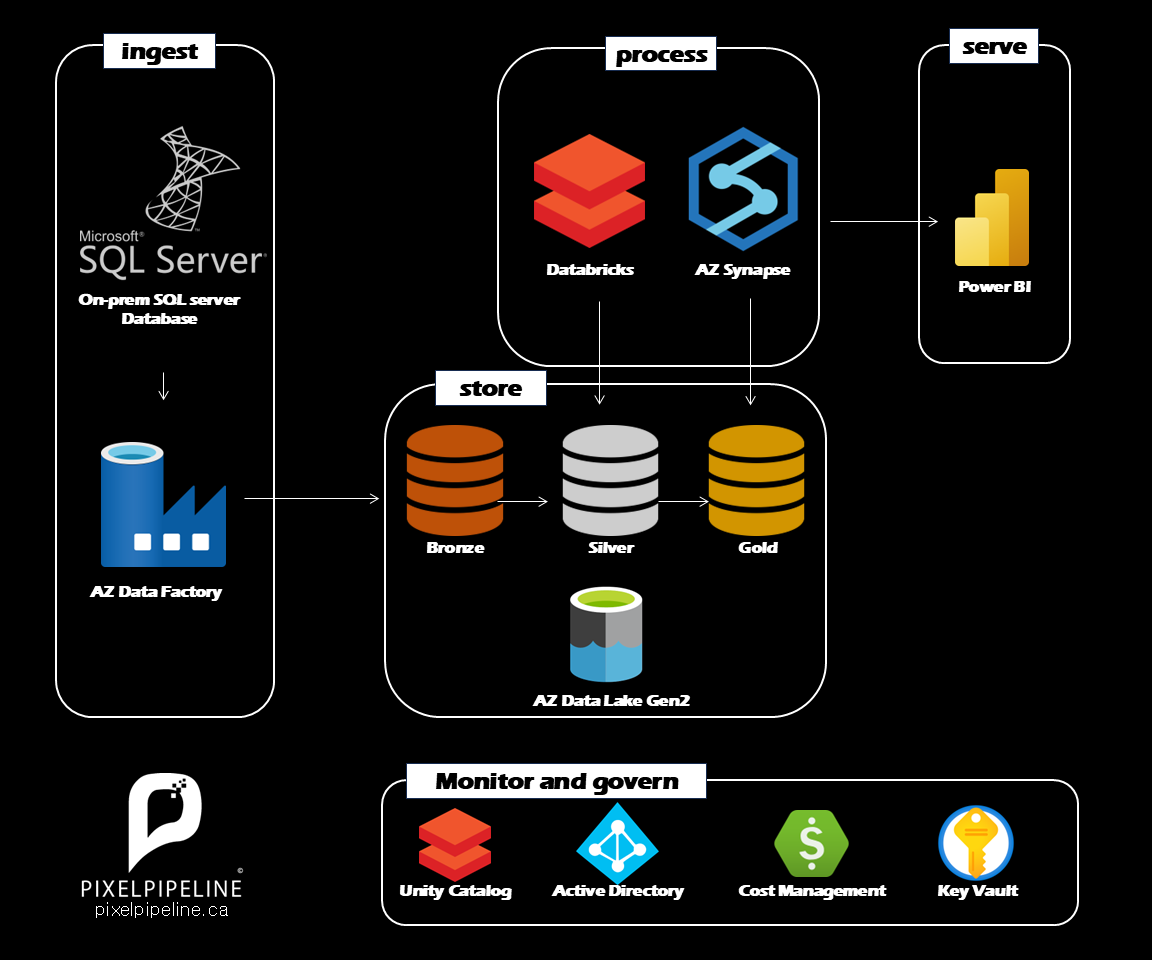
The Architecture: From Legacy to Cloud-Scale
A robust cloud-native platform that modernizes and consolidates on-premises SQL environments into Azure.
On-Premises Ingestion
Securely migrates legacy Microsoft SQL Server data using Azure Data Factory with high throughput and data integrity.
Modern Processing Power
Leverages Azure Databricks for massive-scale Spark transformations and Azure Synapse for enterprise data warehousing.
Medallion Lakehouse Architecture
Organizes raw data into a Bronze, Silver, and Gold Medallion pattern within Azure Data Lake Gen2.
Enterprise-Grade Insight Serving
Connects Power BI directly to the Gold layer for real-time executive dashboarding and KPIs.
Unified Governance & Security
Secured via Databricks Unity Catalog, Azure Active Directory, and Azure Key Vault for credentials.
Architectural Pattern: Layered Architecture (N-tier)
The system is built on a clean Layered Architecture (N-tier), ensuring separation of concerns:
- Data Ingestion Layer: Moves on-prem data via Azure Data Factory.
- Processing Layer: Handles large-scale transformations via Azure Databricks and Synapse.
- Storage & Serving Layer: ADLS Gen2 Lakehouse and Power BI for intuitive reporting.
Functional Requirements
- Data Migration: Extract data from on-premises SQL servers to Azure cloud securely.
- Data Transformation: Clean and aggregate data into a Medallion architecture (Bronze, Silver, Gold).
- Business Intelligence: Provide real-time dashboards and KPIs via Power BI.
- Secret Management: Securely store connection credentials and tokens without hardcoding.
Non-Functional Requirements
- Performance: speed and responsiveness via Azure Databricks Spark clusters.
- Security: protection against unauthorized access enforced by Azure Active Directory and Key Vault.
- Usability: ease of use provided by seamless Power BI dashboard integrations.
- Reliability: system stability and availability maintained by managed Azure Data Factory pipelines.
- Scalability: ability to handle growth via elastic Azure Synapse data warehousing.
- Maintainability: ease of updates and fixes using centralized Unity Catalog governance.
- Portability: ability to run in different environments due to decoupled storage (ADLS) and compute (Databricks).