Detecting Anomalies in IoT Telemetry
Transforming Raw Streams into Intelligent Action with Microsoft Fabric
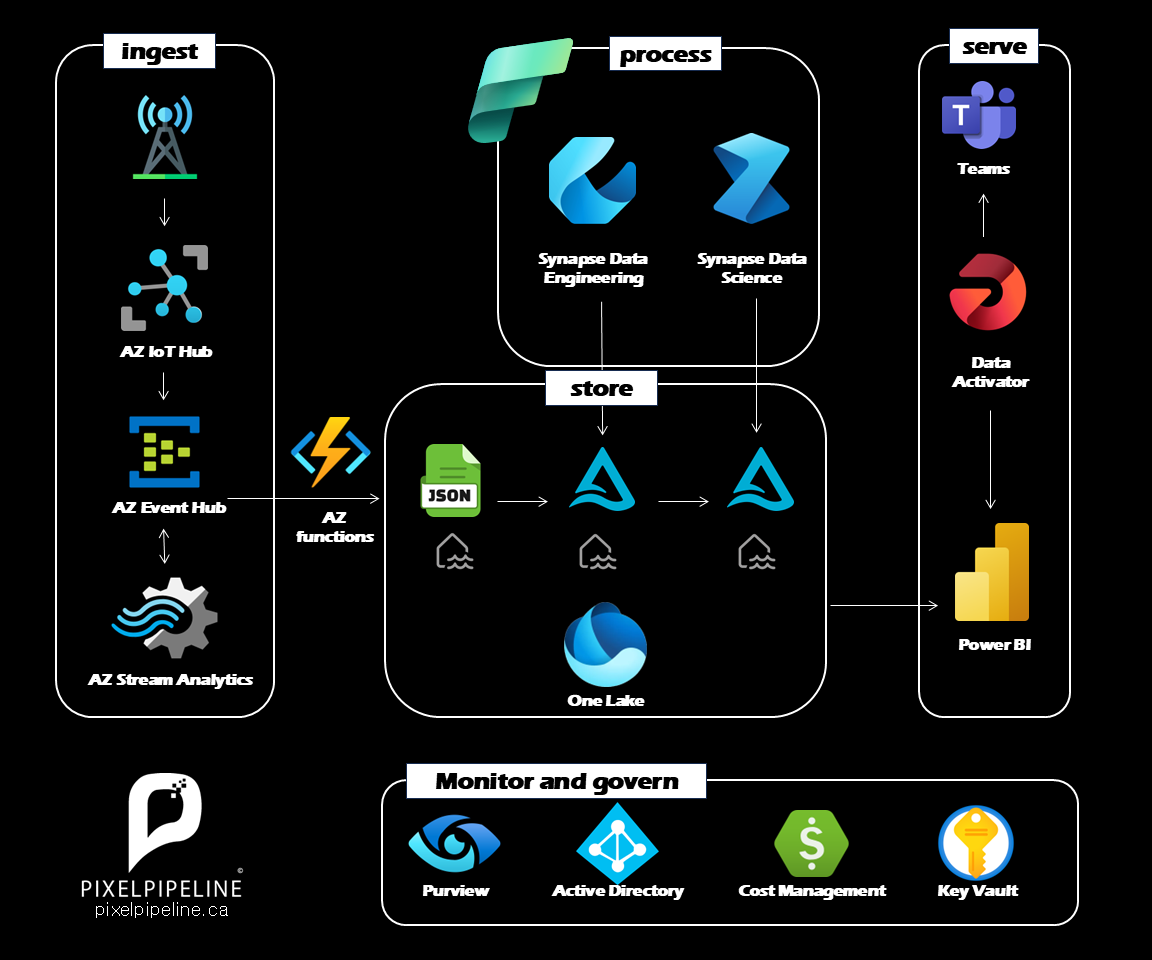
The Architecture: An Intelligent Ecosystem
A unified data intelligence ecosystem built on Microsoft Fabric that transforms high-velocity IoT telemetry into real-time insights.
High-Velocity Ingestion
Captures telemetry at scale via Azure IoT Hub, Event Hubs, and Stream Analytics with zero data loss.
Serverless Orchestration
Azure Functions serve as serverless microservices to pre-process, clean, and validate raw JSON streams.
The Unified Lakehouse (OneLake)
Implements a Medallion Architecture (Bronze/Silver/Gold) on OneLake using the open Delta format.
Advanced AI & Engineering
Synapse Data Engineering and Data Science deploy large-scale transformations and ML anomaly detection models directly on the Lakehouse.
Intelligent Serving & Action
Power BI provides live dashboards while Data Activator triggers instant Microsoft Teams alerts on threshold breaches.
Enterprise-Grade Governance
Governed by Microsoft Purview, secured via Azure Active Directory and Key Vault.
Architectural Pattern: Layered Architecture (N-tier)
The system is built on a clean Layered Architecture (N-tier), ensuring separation of concerns:
- Data Ingestion Layer: Captures high-velocity IoT streams via Azure IoT Hub and Event Hubs.
- Processing Layer: Handles real-time parsing with Azure Functions and AI modeling via Synapse.
- Storage & Serving Layer: Microsoft Fabric OneLake Lakehouse coupled with Power BI and Data Activator.
Functional Requirements
- IoT Telemetry Ingestion: Capture and stream high-velocity sensor data with zero loss.
- Anomaly Detection: Apply Machine Learning models to identify real-time anomalies.
- Automated Alerting: Trigger instant notifications via Microsoft Teams when thresholds are breached.
- Data Lakehouse Management: Organize data into Bronze, Silver, and Gold tiers using Delta Lake.
Non-Functional Requirements
- Performance: speed and responsiveness via Azure Stream Analytics and serverless Azure Functions.
- Security: protection against unauthorized access enforced by Azure Active Directory and Key Vault.
- Usability: ease of use provided by automated Data Activator triggers and Power BI.
- Reliability: system stability and availability maintained by unified Microsoft Fabric infrastructure.
- Scalability: ability to handle growth via limitless OneLake storage and scalable Synapse engineering.
- Maintainability: ease of updates and fixes using centralized Microsoft Purview governance.
- Portability: ability to run in different environments due to the open Delta storage format.